

The False Positives of Oncologic Progress
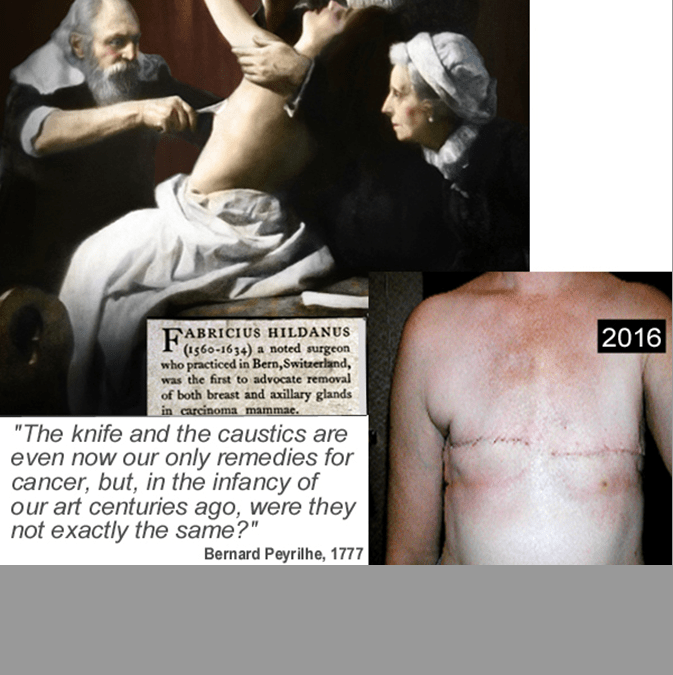
The distrust in our ingenious pharmacological and biological therapies for cancer is evidenced by the fact that we continue removing precious and meaningful organs from women as soon as a cancer the size of a lentil or a pea is discovered in their breasts. In other words, despite our apparent exceptional progress in molecular and genetic therapeutics of cancer, we continue removing one or both breasts and emptying the axillary pits from lymph nodes in women as young as 25, in the same way we have been doing for the last 500 years (see image below). What hopes can we offer to a patient with locally advanced or metastatic breast cancer?
On the other hand, the two main reasons for patients with metastatic cancer undergo chemotherapy are to live longer and to live better. A recent study involving 312 patients with metastatic disease has found that such treatment achieves neither of those goals. Researchers examined the effect of chemotherapy on patient quality of life in the last week of life as a function of patients’ performance status, which ranks their ability to perform activities such as be ambulatory, do work and handle self-care. They found that those patients have a significantly worse quality of life during their final weeks than those patients who did not receive chemotherapy, according to the study published in JAMA Oncology on September 2015. In addition, the highest functioning patients entering the trial resulted as those whose quality of life in the last week of life was “significantly and meaningfully lower than in those not receiving chemotherapy” [8].
REFERENCES
- Stewart BW, Wild C, editors. World cancer report 2014. Lyon, France: International Agency for Research on Cancer, World Health Organization; 2014.
- Ward E, DeSantis C, Robbins A, Kohler B, Jemal A. Childhood and adolescent cancer statistics, 2014. CA Cancer J Clin. 2014; 64:83-103.
- Twombly R. Cancer surpasses heart disease as leading cause of death for all but the very elderly. J Natl Cancer Inst. 2005; 97:330-331.
- American Cancer Society. Cancer facts & figures 2014. Atlanta: American Cancer Society; 2014.
- Bailar JC, 3rd, Gornik HL. Cancer undefeated. N Eng J Med. 1997; 336:1569-74.
- Morgan G, Ward R, Barton M. The contribution of cytotoxic chemotherapy to 5-year survival in adult malignancies. Clin Oncol 2004; 16:549-60.
- Faguet GB. The Conquest of Cancer: A distant goal. Dordrecht, The Netherlands Springer; 2015.
- Prigerson, HG., et al. Chemotherapy Use, Performance Status, and Quality of Life at the End of Life. JAMA Oncol. 2015;1:778-784.